Do Minority Writers Have an Advantage?

Mulberry Street NYC ca.1900. edit of Image:Mul...

Mulberry Street NYC ca.1900. edit of Image:Mulberry Street NYC c1900 LOC 3g04637u.jpg by me user debivort. 1px median filtered, and then downsampled. (Photo credit: Wikipedia)

American Readers Like Unconventional Characters, but…

In an article Amit Mujmudar wrote for the NY Times on May 5 entitled Am I an ‘Immigrant Writer‘?,  he explores writing for the American fiction reading world as a minority.    Almost immediately he concludes that “a minority author may well have an advantage”.  It stems from the American reader’s appetite for stories about people who live in “other” ways.  So, there is the element of novelty when readers pick up a book written by a minority author, but there’s also a rub:  readers want to see themselves in the characters they read about.  Is this a deal breaker?


Cover of "Monsoon Wedding"

Cover of Monsoon Wedding

Attaining the Universal Through the Particular

Mujmudar notes that minority writers in particular need to hurdle any divide whether it’s religion, geography, ethnicity or anything else that would prevent readers from recognizing themselves in the  characters of  a story.  It goes with the territory. My mind immediately leaps to movies. In the foreign movie Monsoon Wedding, audiences relish the novelty of the lush Indian music, sensuous dancing, and thoroughly Indian family participation in, and the lavish preparation for the wedding. But what carries the movie in the end, is the moral dilemma facing the father of the bride, a dilemma that all audiences recognize. The way in which the father resolves the dilemma resonates with all audiences, and together with his generosity toward lower class newly weds reveals a crack that is opening in the inborn Indian caste system.  Mujmudar writes “the book’s (or movie’s) success is proportional to the extent its cultural strangeness dissolves in the reading (or viewing).

Minority Threads

Minority Threads (Photo credit: simplyla)

Realism in Stories

Mujmudar points to the current of realism that runs through popular American literature of the day. Let me add theater and cinema to this.   Realism is enhanced by observed detail and authoritative voice provided by the author.  This works in favor of the author who can provide it.  Amit writes: “Readers don’t want differences to estrange them—for all their curiosity, they actually want the differences to disappear. They want to recognize themselves.”  The context of the immigrant writer begins to fade right about here.  In some sense, aren’t we all immigrant writers? If we follow the mantra of current realistic story telling, we write about what we know, about our own experience.  If we do it well, we can write as Amit says, “characters specific enough to be anyone”.

What novels, plays, movies can you cite that transcend the particular to achieve the universal?


Enhanced by Zemanta
Posted in Opinion, Writing | 11 Comments

When Weak Old Work Becomes Vibrant New Work

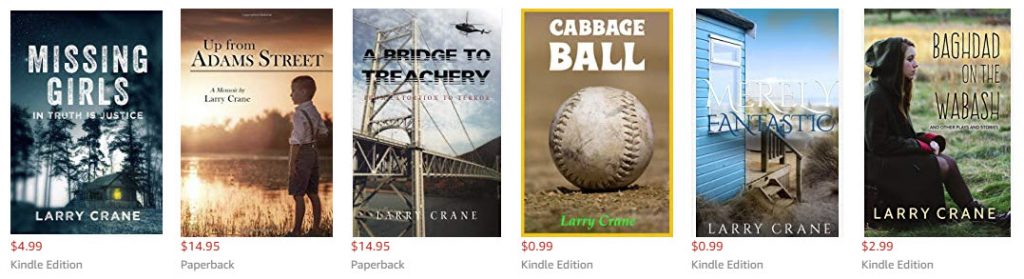
BaghdadCover2

A good idea is a good idea, period.  Right? Yes!  When I first wrote a number of short stories and plays, the impetus for writing them was that they represented truth as I knew it.  Now, I reread them and find that the development of the idea seems weak.  I did a fairly decent job, but today it’s not flying.  I’m older and wiser, or something. So, I go at it again on the same terrain.  And voila!  I present for your delectation: Baghdad on the Wabash, And Other Plays and Stories.

Baghdad on the Wabash is a full length play, and is the major work in this collection of stories and plays. It tells the story of the Beach family assembling on the banks of the Wabash River in Illinois to receive the remains of Jim Beach who was missing in action in the Vietnam War until his remains were discovered years after the conflict is over. Like the country as whole, the Beach family is divided on the issue of the war. Into this troubled reunion steps Sydney, the 15 year old daughter of the fallen soldier with her irreverent prickliness and questioning attitude that helps the family find a way to do the right thing.

Two short stories are the first entries in this collection. In Learning Something, a young man spends a week in New York as a part of his training for job in the brokerage business. Rudesheim and the Roosevelt tells of Billy and Mila going to the Roosevelt Hotel Ball Room in celebration of their tenth wedding anniversary, and finding themselves replaying an old record.

Four ten-minute plays follow. In Smoke, a marital separation encourages an old friend to try to rekindle romance. A Little More Connecticut brings married veteran actors together with an ambitious young director to rehearse a made for TV movie, with hilarious consequences. Aiming Off finds Alma and Brandon getting together at a forest preserve to negotiate the terrain of their brittle relationship. Chicken Tonight explores how an unlikely friendship can develop in a supermarket.

I’m working toward epublishing this collection.  It will be coming along straight away.

Did you enjoy this article? Subscribe to my blog and you’ll never miss my periodic posts! Just enter your email address in the upper right corner of this page. It’s easy.  It’s free, and I won’t share your contact information with anyone!


Enhanced by Zemanta
Posted in Opinion, Theatre, Writing | 6 Comments

Reflections on Writing a Ten Minute Play

The Granddaddy of American Short Play

Downtown New York

Downtown New York (Photo credit: sreevishnu)

Festivals As Catalyst for Action

The deadline for submitting an entry for the 38th Annual Samuel French Off Off Broadway Short Play Festival has come and gone. Forty finalists will be chosen by a reading panel from over 900 submissions.  The forty finalist plays will be performed live in a week long festival in New York, the mecca of American Theater,  to determine which six will remain standing at the end.  It’s tremendously exciting to contemplate winning a spot in the final half dozen, and I won’t spoil my fun with doubt that my entry “Smoke” has the remotest chance.  But, credit the French OOB Festival for creating my impetus for putting pen to paper at all.

How did I find my story?

It came from another story.  I had a full length play that was in the drawer for quite a while, but I thought it still had potential.  It was set in a run down bar and grill.  I have been tweaking it for months, years.  One interesting tweak had to do with going after the building with a bulldozer in order to transform it into a modern upscale restaurant. This transformation would be a metaphor for remodeling the primary character relationship in the play.  So, I started out with a man and a woman in a run down bar and grill. Somehow these two people would change things by altering the bar.  That was it.

Do Complications Make a Story?

As soon as I had my characters on their feet, they needed to start talking and moving.  That’s what a play is.  I decided the woman would be advising the man on the commercial potential for the bar.  But the possibilities for the bar would to be secondary to the possibilities for the characters.  My mind leaped to my brother’s experience of being contacted by an old girlfriend from high school days.  This morphed into the complications such a meeting create for the man and his wife. So, now I had three characters, man and wife and old girlfriend.

Does the Form Affect the Story?

Without question it does.  A character does something that provokes a response from another character.  In the play form, this “something” is words or physical action. The playwright can “show” what is happening through dialogue or through written stage directions.  Unlike a short story, there is no opportunity to have a character meditate or remember or do something else that takes place in the thoughts of a character.  Every written expression in the play script is a line of dialogue or a stage direction that propels the story forward.  And so, a play can be thought of as the purest form of story telling. The playwright needs to convey all manner of emotions, remembrance, deceit, fear, etc. etc. directly through dialogue and written stage directions.

So, What Happened?

I put my characters on their feet.  I gave them things to say and things to do. I implied in dialogue that they were lying, that they were nervous, cheeky, scared, or something else to convey that they could lose what they wanted most.  It was completely free form except the dialogue had to sound right and feel true.  One false word and I was dead.

What else?

One line of dialogue led to the next.  I started up a rhythm.  It flowed. But suddenly a line would feel wrong. I’d tweak it and go on.  To the end.  Then I seized up. What happens at the end? What must happen to make this a real story.  What is a real story? The lead character must change? A lesson must be learned?  I don’t know. But, for this story of mine, written in the 10 minute play form, I have recorded what ‘went down’ under a certain set of circumstances.  If it all rings true to the reader it is satisfying, or it’s disturbing but believable, or some other variation of this.  It’s something.  Something  that happened in the course of the life of these characters.  And it adds to the cumulative truth.

What do you think?

Are you motivated to try writing in the purest form of storytelling?

Did you enjoy this article? Subscribe to my blog and you’ll never miss my periodic posts! Just enter your email address in the upper right corner of this page. It’s easy.  It’s free, and I won’t share your contact information with anyone!


Enhanced by Zemanta
Posted in Theatre | Tagged , , , , , , , | 8 Comments

Trauma Sets Female Veterans Adrift Back Home


English: Cases of PTSD and Severe Depression A...

This is a New York Times article about PTSD and homelessness among female military veterans, a serious problem for our time that demands our attention. Sexual trauma in the military.

http://nyti.ms/XHRUIw 

Related articles

Homeless Female Veterans: All Too Often, a ‘Double Betrayal of Trust’

Enhanced by Zemanta
Posted in Army Subjects | Tagged , , , , | 4 Comments

In coaching, we’re all interim

English: Camp Arifjan, KW - Jim Crews, West Po...

English: Camp Arifjan, KW – Jim Crews, West Point head coach, goes over the second half game plan with his Camp Buehring, Kuwait basketball team during halftime at the Operation Hardwood basketball tournament May 26. (Photo credit: Wikipedia)

This is an article in the Washington Post by John Feinstein, a great friend of West Point athletics. The subject is basketball, a sport near to my heart. It’s about the season that has unfolded for the St Louis Billikens this year after they lost their head coach, Rick Majerus, to heart disease.  It is also about Jim Crews, the new coach who really is not new. wapo.st/WCNhVG Customize

Related articles

Enhanced by ZemantaDid you enjoy this article? Subscribe to my blog and you’ll never miss my periodic posts! Just enter your email address in the upper right corner of this page. It’s easy.  It’s free, and I won’t share your contact information with anyone!
Posted in Sports | Tagged , , , , , , , , , | Leave a comment

A Golf Course Like No Other

English: Golf balls. Français : Des balles de ...

English: Golf balls. Français : Des balles de golf. (Photo credit: Wikipedia)

This is a captivating video on the subject of designing a golf course with wounded veterans in mind.  We need to be reminded of the ways in which our wounded soldiers discover ways to go on with their lives as they recover from devastating injuries.

http://www.youtube.com/embed/RoY2gyyIYL4?feature=player_detailpage

Did you enjoy this article? Subscribe to my blog and you’ll never miss my periodic posts! Just enter your email address in the upper right corner of this page. It’s easy.  It’s free, and I won’t share your contact information with anyone!

Enhanced by Zemanta
Posted in Army Subjects | Tagged , , , , | 3 Comments

Blogging With Video, Hoping to Go Viral

Image representing YouTube as depicted in Crun...

Image via CrunchBase

This is an article from the NY Times Personal Tech Section by Kate Murphy on the subject of using video in your blog.  Right off the bat Kate reveals what you may already know: 90% of YouTube videos are painful to watch.  So, I immediately began to revisit my cringes at watching my own video introduction to this blog.  But another thing she implies is that almost everyone is not a hit the first time out of the box either.  So, there’s hope.

By the way, you certainly don’t have to harbor any thoughts about  going viral with your video.  Being passable is enough.

http://nyti.ms/YhsySO

Did you enjoy this article? Subscribe to my blog and you’ll never miss my periodic posts! Just enter your email address in the upper right corner of this page. It’s easy.  It’s free, and I won’t share your contact information with anyone!

Enhanced by Zemanta
Posted in Social Media | Tagged , , , , , | 5 Comments

High Tide on Blizzard Day

Tide

Tide (Photo credit: Jamie Anderson)

This is a YouTube video of the Blizzard that hit the East Coast on Feb 9, 2013.  The footage is the high tide surf out in front of our home at Cape Newagen, Maine.

http://youtu.be/7Fw7ITC1jd0

Did you enjoy this article? Subscribe to my blog and you’ll never miss my periodic posts! Just enter your email address in the upper right corner of this page. It’s easy.  It’s free, and I won’t share your contact information with anyone!

Enhanced by Zemanta
Posted in Opinion | Tagged , , , , | 4 Comments

Masters of the Craft – Wm. G. Tapply – The Worthy Villain

Writer Wordart

Writer Wordart (Photo credit: MarkGregory007)

William G. Tapply is the author of about 40 books, including more than two dozen New England-based mystery novels. Hell Bent: A Brady Coyne Novel is the most recent. Tapply’s handbook, The Elements of Mystery Fiction: Writing a Modern Whodunit, is used in writing classes and workshops across the country. He has also written a dozen books and nearly a thousand magazine articles, mostly about fly fishing and the outdoors. He is a Contributing Editor for Field & Stream, a columnist for American Angler, and a member of the Editorial Board for The Writer magazine. Tapply is a professor of English at Clark University in Worcester, MA, where he is the Writer in Residence. He and his wife, novelist Vicki Stiefel, run The Writers Studio at Chickadee Farm. Tapply lives and writes in Hancock, New Hampshire. He welcomes visitors to his website: www.williamgtapply.com

Here, he writes about Villains.  If you’re a writer or a reader, you’ll like it: http://www.williamgtapply.com/article6.html


Enhanced by Zemanta
Posted in Writing | Tagged , , , | 6 Comments

Review of “Southeast to Panama” – Robert C. Devine

DevineDevine’s lifelong passion for sailing serves him well as a crewman aboard a catamaran sailboat bound from Puerto Vallarta to Fort Lauderdale via the Panama Canal.  Indeed, he casts himself as the narrator and protagonist in this tale of adventure, intrigue and romance. The plot revolves around a disparate hired crew of four men who are charged with the task of “transporting” an aged sixty-five foot boat over dangerous waters.

Devine is the “details man” in the crew.  Before they set sail, he is to inventory all of the equipment and fittings aboard the boat complete with a diagram of where they are located, and how functional they are.  What’s more, he is the ship’s “provisioner”, the guy who sees to it that all of the meals they will consume en-route are purchased and stowed with a meticulous first-in-last-out methodology.

Panama Canal Sailboat Centre Tied

Panama Canal Sailboat Centre Tied (Photo credit: Wikipedia)

The reader looking for an authentic depiction of a crewman’s life aboard a craft such as this, the duties, the layout of the boat, “watch” assignments, reactions to weather conditions and other contingencies will not be disappointed.  Devine is ready with an explanation of nautical terminology, navigation, communication, and the command hierarchy of the voyage to say nothing of the description of each of the ports large and small that are stops along the way.  It’s a gold mine of details about an actual sailing voyage through the Panama Canal. However, when the writer goes for something more in the text than hour by hour diary entries, the figurative sails of the yarn go slack, and the reader looks about for an editor.

Posted in Reviews/Interviews | Tagged , , , , , | 2 Comments